
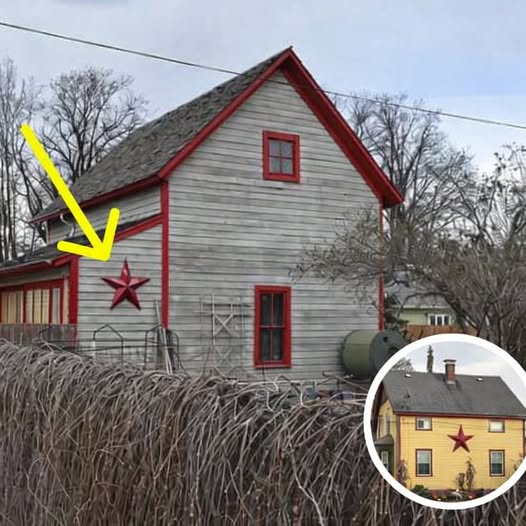
For a brief moment at the end of 2020, a strange rumor took on a life of its own online. Social media posts began circulating claims that homes displaying five-pointed stars were secretly advertising that the residents were “swingers.” The idea spread fast, fueled by screenshots, anecdotes, and the familiar confidence of posts that offer no proof but plenty of certainty. For some homeowners, the rumor was confusing. For others, it was unsettling. And for anyone familiar with the symbol’s real history, it was simply wrong.
The claim didn’t originate from any credible source, study, or documented cultural practice. Investigations quickly traced it back to a long-forgotten message board post from 2007, where speculation had been presented as fact. Over time, the claim resurfaced, stripped of context, and repackaged for viral consumption. By December 2020, it had reached a much larger audience, many of whom had never encountered the symbol before and were primed to believe there was something hidden behind it.
The reality is far more ordinary—and far more meaningful.
The stars in question are commonly referred to as barn stars or Amish barn stars. They are traditional decorative elements that have been part of rural American architecture for generations, particularly in areas associated with the Pennsylvania Dutch. Despite the name, the Pennsylvania Dutch are not Dutch in the modern sense; the term comes from “Deutsch,” referring to their German roots. These communities trace their heritage primarily to southern Germany and brought their customs, craftsmanship, and symbolism with them when they settled in the United States.
Barn stars were most often mounted on barns, homes, and outbuildings, especially throughout Pennsylvania and surrounding regions. Over time, they became a recognizable feature of the rural landscape. Their purpose was never secretive. They were meant to be seen.
Ask different families or historians what a barn star “means,” and you may hear slightly different answers, but they all fall within the same general theme. Traditionally, barn stars have been associated with good fortune, protection, and prosperity. Some believed they helped guard against misfortune or bad weather. Others saw them as symbols of hope, stability, or divine blessing. In many cases, they simply represented pride in one’s home and heritage.
Color interpretations sometimes enter the discussion, adding another layer of folklore. A black star might be said to symbolize protection. A green one could be associated with growth or fertility. Brown might represent friendship or strength. These meanings, however, are cultural traditions, not fixed rules. There has never been a universal code or standardized system dictating what a star’s color signifies. What mattered most was the presence of the star itself, not a hidden message embedded within it.
As rural aesthetics gained popularity beyond farming communities, barn stars spread well outside their original geographic and cultural roots. They began appearing on suburban homes, garden sheds, fences, and even interior walls. Today, they are widely sold as decorative items in home goods stores, craft shops, and online marketplaces. Many people who display them do so simply because they like the look, appreciate rustic design, or want a nod to traditional Americana.
This widespread commercial availability is one of the strongest arguments against the rumor. If barn stars truly functioned as a coded signal for a private lifestyle, they would not be mass-produced and sold openly without explanation. There is no evidence—historical, sociological, or anecdotal from credible sources—that these stars have ever served as an invitation, signal, or identifier for any kind of sexual or social practice.
The swinger claim also collapses under basic scrutiny. Communities involved in consensual non-monogamy do not rely on permanent, highly visible markers on their homes to identify one another. Such practices, when they exist, rely on private communication, not symbols that could be misinterpreted by neighbors, children, or strangers. The idea that a centuries-old folk symbol would suddenly serve this function makes little sense.
What the rumor does illustrate is how quickly misinformation can spread when it taps into curiosity and discomfort. Symbols are powerful, and when people don’t know their origins, they become easy targets for reinterpretation. Social media amplifies this effect, rewarding posts that surprise or shock rather than those that explain. A claim doesn’t need to be true to go viral; it just needs to feel intriguing.
For homeowners who found themselves questioning a decoration they’d lived with for years, the episode was a reminder of how fragile shared understanding can be. A symbol that once represented tradition and pride was suddenly framed as something provocative or inappropriate, not because its meaning had changed, but because a false narrative had been attached to it.
Understanding the true origins of barn stars restores them to their proper context. They are artifacts of cultural history, not secret signals. They reflect the values of the communities that created them: practicality, craftsmanship, faith, and continuity. Like many traditional symbols, they have been carried forward not because everyone knows their exact meaning, but because they feel rooted, familiar, and enduring.
When myths like this arise, they tend to say more about modern anxieties than about the past. We live in a time when people expect hidden meanings everywhere, when suspicion often replaces curiosity. The barn star rumor thrived not because it made sense, but because it played into the idea that ordinary things are never just ordinary.
In truth, a star on a house is usually just that: a star. A decorative object with a long, visible history and no secret agenda. Recognizing this allows us to appreciate the symbol for what it actually represents—heritage, craftsmanship, and a connection to generations who marked their homes with symbols of hope and protection, not coded messages.
Stripping away the misinformation doesn’t make the story less interesting. It makes it more honest. And in a landscape crowded with viral half-truths, that honesty matters.