
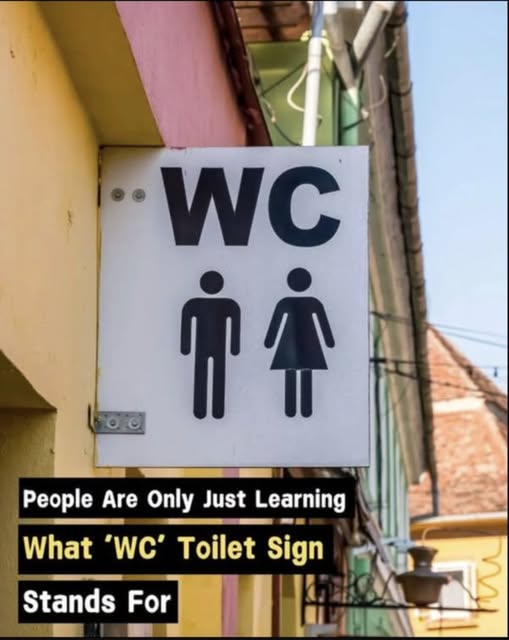
For the uninitiated traveler, the sight of the letters “WC” emblazoned on a door in a bustling international airport or a quiet European bistro can trigger a moment of genuine confusion. What exactly is a “WC,” and why has this specific acronym become the universal shorthand for a room containing a porcelain throne and a basin?
If you have ever found yourself puzzled by the signage, you are far from alone. Across the globe, digital communities are currently engaged in a spirited effort to unravel the mystery of the “Water Closet”—a term that, for many, makes no more literal sense than “restroom,” “bathroom,” or “loo.”
The “Washroom” Debate: TikTok’s North American Divide
The conversation surged into the mainstream recently when a couple, Shelby and Dylan, shared a viral TikTok highlighting the subtle but distinct linguistic barrier between American and Canadian sensibilities.
“What in the world is a washroom?” Dylan asks, his camera tracking a sign in a Canadian facility. “And what are they washing in there? Oh, it’s a restroom. The only thing I wash in there is my hands.”
The exchange prompted a quick retort from Shelby off-camera: “Do you rest in a restroom?”
The video served as a lightning rod for online users, who flooded the comments to defend their preferred euphemisms. One follower recounted an awkward encounter at Disneyland, noting that when they “asked for the washroom,” they were mistakenly directed to a laundromat. Another user offered a succinct summary of the chaos: “Wait ‘til he finds out about water closets.”
Etymology of the “Water Closet”
According to Merriam-Webster, a “water closet” is defined as a compartment or room equipped with a toilet, or the toilet bowl and its accessories themselves. The history of the term is rooted in a time when domestic spaces were strictly partitioned by function.
Historically, a “bathroom” was a room explicitly for bathing. A “restroom” was a space to “rest” or prepare for the day using a mirror and sink. If one needed to attend to biological necessities, they sought out the “toilet” located within the “water closet.”
The 19th-Century Shift: From Outhouses to Indoor Plumbing
Prior to the late 19th century in America, indoor facilities were a luxury of the elite; the majority of the population relied on outhouses or outdoor sanitary structures. While wealthy homes featured “bathrooms,” these were traditionally devoid of toilets.
The landscape shifted by 1890 with the advent of the mechanized water closet. These early indoor toilets were housed in small, dedicated rooms separate from the bathing area to maintain hygiene and privacy. It wasn’t until the early 20th century that the modern “integrated” bathroom—combining the bathtub and the toilet into a single footprint—became the architectural standard to save space and simplify plumbing.
A Global Lexicon: “The Necessary Place”
The debate has found a permanent home on Reddit, where users from various cultures have attempted to demystify the terminology. In a thread titled “Why is a public WC called bathroom if there is [no] bath?”, contributors noted that “bathroom” and “restroom” are essentially American euphemisms for a “room with a toilet,” whereas the rest of the world leans toward “WC,” “lavatory,” or “loo.”
The international variations are as fascinating as they are diverse:
- Russia: The term often translates to “a room without windows,” regardless of whether a window actually exists.
- Esperanto: The word is necesejo, literally meaning “the necessary place.”
- Canada: The term “washroom” remains the national standard, a preference shared by some regions of the American Midwest.
In the modern era, “WC” remains the preferred signage for airports, hotels, and restaurants catering to an international clientele. It serves as a formal, universal indicator that transcends local slang, ensuring that no matter what you call it at home, you can find what you need abroad.