
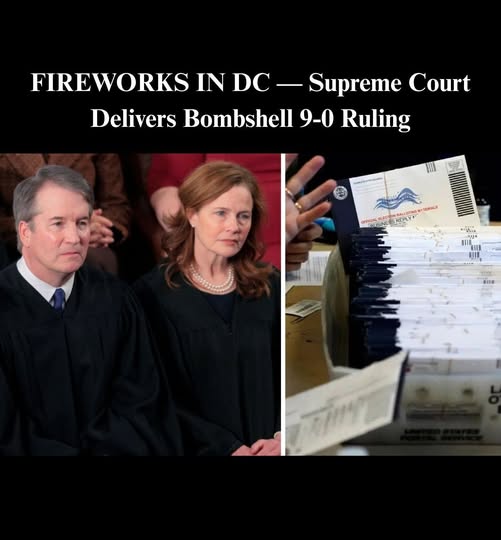
Supreme Court Could Still Tilt Midterms Toward Republicans
The U.S. Supreme Court made headlines last week when it ruled to keep New York’s current congressional map in place, temporarily blocking a lower court ruling that had found the map violated the Constitution by diluting the voting power of Black and Latino residents.
The unsigned emergency order did not include a vote count or written reasoning, which is typical for decisions issued on the court’s emergency docket. The decision allows the existing map to remain in place while appeals continue, making it likely the map will be used in the upcoming midterm elections.
The ruling was a victory for Republicans and could help them retain control of a closely divided House of Representatives.
Representative Nicole Malliotakis, a Republican whose district includes Staten Island and parts of southern Brooklyn, filed the emergency application after a state judge ordered her district to be redrawn.
The case centers on New York’s 11th Congressional District, the only district in New York City currently held by a Republican.
That ruling comes as the Supreme Court is expected to issue a decision in a Louisiana redistricting case that could affect how the Voting Rights Act is applied in election disputes.
The case, Louisiana v. Callais, challenges a congressional map approved by Louisiana lawmakers that created a second majority Black district after earlier court challenges.
The dispute centers on Section 2 of the Voting Rights Act of 1965, which allows private individuals and organizations to challenge election laws or redistricting plans they argue dilute the voting power of minority communities, The Intelligencer reported.
The Supreme Court previously ordered the case to be reargued, a step that signaled the justices may revisit how race can be considered when drawing congressional districts.
During oral arguments, the justices examined whether the use of race to create majority minority districts could conflict with the Equal Protection Clause of the 14th Amendment.
Section 2 of the Voting Rights Act has been the primary legal tool for challenging redistricting plans since the Supreme Court’s 2013 decision in Shelby County v. Holder.
That ruling eliminated the law’s preclearance provision, which previously required certain states to obtain federal approval before implementing changes to election laws.
A decision could also influence future redistricting efforts in states where one party controls the legislature and the governor’s office.
Analysts have pointed to several states, including Georgia, South Carolina, Tennessee, Missouri, and Florida, where new congressional maps could potentially be considered ahead of the 2026 midterm elections, depending on the outcome of the case.
Chief Justice John Roberts, the author of the 2023 Allen v. Milligan ruling that requires the establishment of a second majority-Black district in Alabama, examined whether this framework is consistent with Allen and the Court’s Thornburg v. Gingles criteria.
The test mandates that plaintiffs demonstrate a minority group is not only sizable and cohesive but also experiences majority bloc voting that undermines their electoral candidates. Roberts appeared focused on aligning the proposal with established norms, steering clear of a complete transformation.
Justice Brett Kavanaugh, an influential voice in the Allen case alongside Roberts and the liberal justices, raised the possibility of a “sunset” clause for Section 2 remedies, referencing precedents that restrict race-based policies to temporary solutions.