
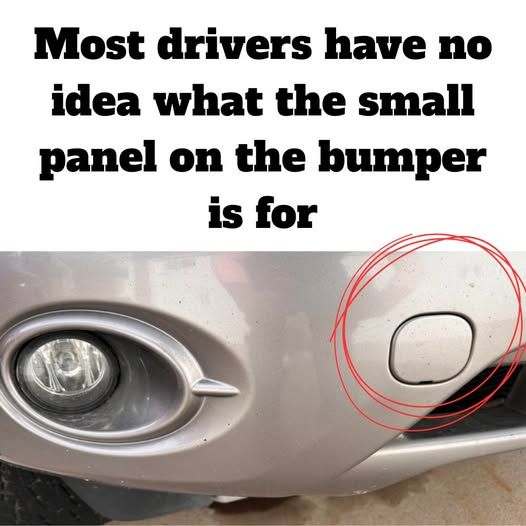
Most drivers walk past it every day without a second glance—a small, square or round panel tucked neatly into the bumper, designed to blend in and stay unnoticed. It looks decorative, almost meaningless. But that hidden panel exists for a critical reason, and in the wrong moment, not knowing its purpose can turn a manageable breakdown into an expensive and stressful disaster. That discreet cover hides one of the most important safety features your vehicle has: the designated towing point engineered to protect your car when it can no longer protect itself.
Behind that panel sits a reinforced, threaded socket built directly into the vehicle’s frame. This is where a tow hook securely attaches, allowing your car to be moved without causing damage to its body, suspension, or steering components. When a vehicle is towed improperly—by a bumper edge, suspension arm, or random metal part—the strain can warp panels, tear plastic trim, or damage critical systems that cost far more to repair than the original problem. The towing point hidden behind that cover exists to absorb and distribute force safely, ensuring your vehicle can be relocated without adding new damage to an already stressful situation.
Vehicle designs vary, but the principle remains the same. Some cars have towing covers on both the front and rear bumpers, offering flexibility depending on the situation, while others provide just one access point. These covers are always positioned where the vehicle’s structure is strongest, even if their placement isn’t immediately obvious. Luxury vehicles and SUVs often include multiple towing points, while compact cars may rely on a single reinforced mount. Once you know what to look for, spotting that subtle panel becomes easy—and knowing its purpose makes it far more than a cosmetic detail. Maintenance matters too. If the towing cover is missing, replacing it is simple and affordable. Dealerships, auto parts stores, and online retailers carry snap-in replacements designed to fit without special tools. Beyond appearance, the cover protects the towing socket from dirt, moisture, and corrosion that could weaken it over time. A neglected towing point can seize or rust, rendering it useless when you need it most. Keeping that small panel intact ensures the mechanism behind it stays reliable, ready for emergencies rather than failing at the worst possible moment.
Preparedness goes beyond spotting the cover. Many drivers don’t realize that the tow hook itself is usually stored with the spare tire and roadside tools. Familiarizing yourself with its location and how it attaches takes minutes but can save hours of confusion during a breakdown or accident. Whether you’re stranded on a quiet road or dealing with an unexpected situation in bad weather, knowing how your vehicle is designed to be helped can turn panic into control. That unassuming panel on your bumper isn’t just part of the design—it’s proof that smart engineering anticipates trouble before it happens, quietly waiting to protect you when you need it most.