
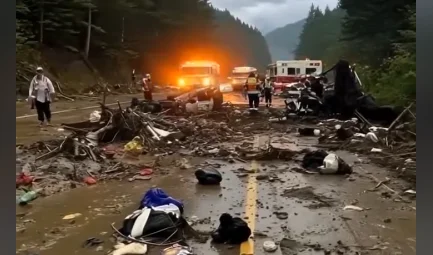
The rugged, winding stretch of Highway 99 near Lillooet, British Columbia, is known to locals and travelers alike as the Duffey Lake Road. It is a route of breathtaking beauty, where steep emerald slopes meet the dramatic peaks of the Coast Mountains. However, on a fateful November afternoon, that beauty turned into a terrifying wall of debris as a massive mudslide thundered down the mountainside, transforming a routine drive into a scene of unimaginable chaos and heartbreak. The disaster, which claimed the lives of four individuals and left a fifth person missing, serves as a harrowing reminder of the fragile boundary between modern infrastructure and the raw, unpredictable power of the natural world.
The catastrophe unfolded following a period of relentless, record-breaking rainfall that had saturated the region’s terrain. At approximately mid-day, the earth simply gave way. A torrent of mud, uprooted trees, and massive boulders swept across the asphalt with the force of a tidal wave, catching several vehicles in its path. Those who witnessed the event described a sound like a low-flying jet engine, followed by a sudden, violent transformation of the landscape. For the drivers caught in the slide’s direct trajectory, there was no time to react. The sheer weight and velocity of the debris pushed vehicles off the shoulder and into the ravines below, burying them under meters of unstable earth and tangled forest remains.
Emergency responders, including Search and Rescue teams from across the province, rushed toward the remote site despite the daunting conditions. The scene they encountered was one of absolute devastation. The highway was severed, and the mountainside continued to groan and shift, threatening those attempting to reach the buried cars. Heavy machinery was brought in to carefully sift through the mud, a painstaking process that required a delicate balance between urgency and the safety of the recovery crews. Over the course of several days, the somber reality of the situation became clear. One by one, the bodies of four victims—one woman and three men—were recovered from the wreckage, their lives cut short on a journey that should have been safe and familiar.
Despite the exhaustive efforts of the recovery teams, a fifth individual remained unaccounted for. For days, crews combed the debris field with K-9 units and specialized equipment, hoping against hope for a miracle. However, as the weather continued to deteriorate and the risk of secondary landslides increased, authorities were forced to make the agonizing decision to halt the search. The terrain had become too perilous to navigate, and the probability of survival had dropped to zero. For the family of the missing victim, the conclusion of the search brought a unique and painful form of grief—a lack of closure in a place where the mountain had claimed one of its own.
In the wake of the disaster, Highway 99 was closed indefinitely. This vital artery, which connects the Lower Mainland to the interior, became a silent monument to the tragedy. Geotechnical engineers and provincial officials were tasked with assessing the stability of the slopes, utilizing drones and aerial surveys to determine if more sections of the mountain were at risk of collapse. The closure sent ripples through the surrounding communities, complicating supply chains and isolating small towns, but the physical inconvenience paled in comparison to the emotional toll on the families involved. The victims were more than just names on a news report; they were parents, friends, and neighbors whose absence left a permanent void in the lives of those who loved them.
Investigators are now working to piece together the specific environmental factors that led to such a catastrophic failure of the slope. While the extreme weather event was the primary catalyst, the disaster has reignited a broader conversation about climate resilience and the safety of mountain corridors. As atmospheric rivers become more frequent and intense, the infrastructure built through these treacherous passes faces unprecedented stress. For the people of British Columbia, the Lillooet slide is a sobering wake-up call regarding the necessity of advanced early-warning systems and more robust slope stabilization efforts along critical transit routes.
The local community near Lillooet has shown remarkable resilience, coming together to support the families of the bereaved and the first responders who witnessed the horror firsthand. Small-town BC is a place where people look out for one another, and the shock of this event has resonated deeply. Memorials, both physical and digital, have begun to appear, honoring the four lives lost and the fifth who remains part of the mountain. Those who regularly travel the Duffey Lake Road now do so with a newfound sense of caution and respect for the land. The familiar curves of the highway, once seen as a scenic highlight of the province, are now viewed through the lens of a tragedy that proved how quickly life can be interrupted by forces far beyond human control.
As the debris is slowly cleared and the highway is eventually fortified and reopened, the memory of that November day will linger. The scars on the mountainside will take years to heal, and the trees that were swept away will be replaced by new growth, but the landscape is forever changed. The Lillooet mudslide is a testament to the fact that even in an age of high-speed travel and advanced technology, we remain at the mercy of the elements. It underscores the fragility of life and the sobering reality that nature does not grant pardons.
The story of the Highway 99 disaster is ultimately one of loss, but it is also one of bravery. From the first responders who waded into the mud to the families who have displayed incredible grace in the face of sudden tragedy, the human spirit has shone through the darkness of the event. As the province moves forward, the lessons learned from this disaster will hopefully inform a safer future for all who traverse the mountains. For now, the focus remains on the families, the mourning, and the quiet dignity of those who were lost in the slide.